
Did you know that 57% of consumers spend more with brands they feel connected to? That emotional bond doesn’t happen by accident. It comes from a comprehensive brand strategy that guides every decision your business makes.
Learning how to create a brand strategy might feel overwhelming at first. But it’s simply a business branding plan that defines who you are, what you stand for, and how you communicate that to your target audience.
Strategic brand development goes far beyond just picking colors or designing a logo. It’s your north star for building trust, fostering customer loyalty, and standing out in a crowded market.
In this guide, you’ll discover the five essential elements every solid brand strategy needs plus a six-step process to build yours from scratch.
Whether you’re launching a new brand or refining an existing one, these frameworks will help you create a brand that resonates with your target customers and drives real business growth. If you’re looking for professional guidance, our branding services can help bring your vision to life.
A brand strategy is a long-term plan that goes beyond visuals. It’s your north star for emotional connection and market positioning that guides every customer touchpoint.
Think of your brand strategy as the blueprint for how you want customers to perceive your business. It determines how you communicate your brand’s purpose, what messages you share, and how you deliver experiences that foster loyalty. A comprehensive brand strategy unifies brand messaging, visual identity, voice, and experiences across all marketing channels to build recognition.
A solid brand strategy isn’t just nice to have. It’s the foundation that separates thriving businesses from forgettable ones. When you define brand strategy effectively, you unlock three powerful advantages that directly impact your bottom line.
Brands with emotional connections see higher customer lifetime value and can charge premium prices. Research shows retention costs five times less than acquisition. When your brand stands for a clear purpose, loyal customers become advocates who spread your message for free. This customer loyalty building transforms one-time buyers into a loyal customer base that fuels sustainable growth through emotional branding.
Consider Dunkin’ versus Starbucks. Both sell coffee, but their brand positioning couldn’t be more different. Dunkin’ emphasizes speed and everyday value. Starbucks creates a premium experience. Neither brand tries to be everything to everyone. Brand differentiation helps you carve out your unique market position so potential customers understand exactly why you’re different.
Here’s something most business owners miss: 69% of professionals want ownership of their company’s brand strategy. When your team understands your brand’s purpose and core values, they make better business decisions. High-growth firms consistently have clearly defined brand strategies. They understand their target market, communicate with a consistent brand voice, and maintain consistency across every touchpoint.
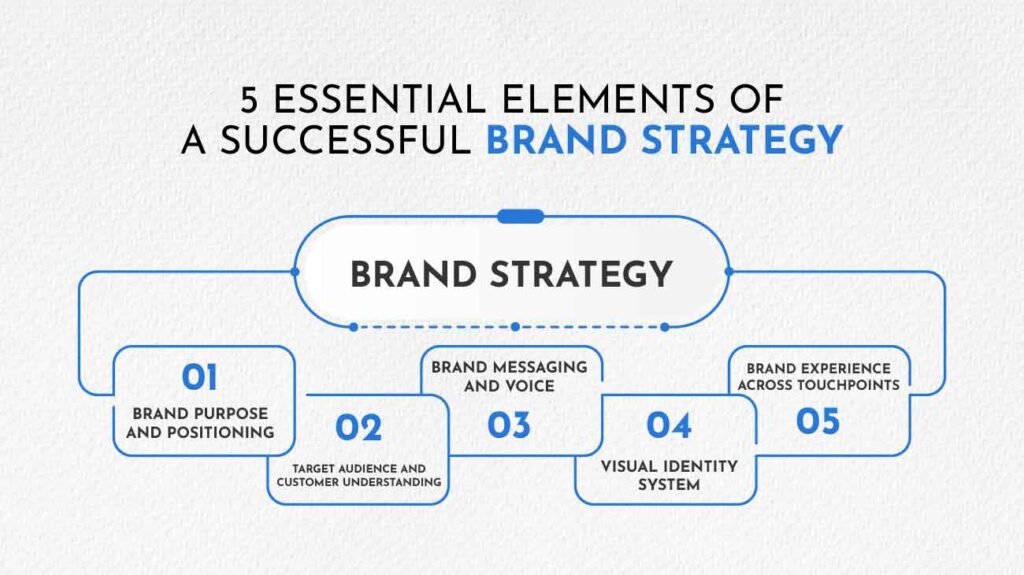
Every great brand strategy rests on five interconnected elements. These brand strategy components work together as an ecosystem, not in isolation. Master these key elements and you’ll have a brand development strategy that guides every marketing effort and business decision you make.
Your brand’s purpose answers a simple question: why does your brand exist beyond making money? This is the authentic brand purpose that drives everything you do.
Patagonia built its entire brand around environmental sustainability. That purpose drives every product decision, marketing campaign, and business partnership. When your brand’s purpose feels genuine, it becomes the foundation for emotional connection with your target audience.
Finding Your Unique Market Position
Brand positioning strategy defines your unique place in the market relative to competitors. A competitive brand positioning strategy requires honest answers to three questions:
Your Positioning Statement Formula
Use this simple framework to craft your unique value proposition:
“For [target audience] who need [specific problem solved], our brand offers [unique benefit]. Unlike [competitor], we [key differentiator].”
Keep it authentic. Your value proposition should flow naturally from what you actually do best. For more insights on developing your brand foundation, check out our B2B brand strategy guide.
Here’s a truth that saves businesses thousands in wasted marketing spend: everybody equals nobody. When you try to appeal to everyone, you end up resonating with no one.
Defining your target audience means getting specific about your ideal customer. You need to understand their pain points, values, behaviors, and aspirations through thorough market research.
Research Methods That Work
Method | What It Reveals | Time Investment |
Customer surveys | Direct feedback on needs and preferences | 2-3 hours to create |
Social listening | Real conversations about your industry | 30 minutes daily |
Customer interviews | Deep insights into motivations | 1 hour per interview |
Build Simple Customer Personas
Your persona should answer:
High-growth firms invest time in understanding exactly who they serve. That knowledge transforms how you create a brand that actually connects.
Your brand messaging strategy defines what you say. Your brand voice determines how you say it. Together, they create the consistent communication that builds brand recognition over time.
Strong brand messaging connects on both emotional and rational levels. Apple has maintained the same messaging framework philosophy for decades. “Think Different” isn’t just a slogan; it’s woven into every product launch, retail experience, and customer interaction.
Components of Effective Brand Messaging
Your messaging framework should include:
Brand voice adds brand personality to these messages. Are you professional and authoritative? Playful and irreverent? Warm and nurturing? Your tone should resonate with your target customers and stay consistent across all marketing materials.
Visual brand identity goes way beyond your logo. It’s the complete visual language that makes your brand instantly recognizable across every touchpoint. A strong visual identity creates immediate recognition and builds brand equity over time.
Logo Design and Usage
Your logo needs to work at any size, from social media avatars to billboard advertisements. Create variations for different contexts but maintain consistency in the core design. Understanding how much brand design costs helps you budget appropriately for professional development.
Color Psychology and Palette
Choose 3-5 core colors that align with your brand personality. Blues convey trust and professionalism. Reds create urgency and excitement. Greens suggest growth and sustainability. Document exact color codes for both digital and print use.
Typography Guidelines
Select 2-3 fonts maximum. One for headlines, one for body copy, and optionally one for accent text. Your typography should reflect your brand voice while remaining readable.
Imagery Style and Standards
Define what types of photos, illustrations, or graphics represent your brand. Strong brand identity creates immediate recognition. When customers perceive your marketing materials, they should know it’s you before reading a single word.
Create Your Brand Style Guide
Document these standards in brand guidelines that your team and partners can reference. Include specifications for logo usage, color codes, font choices, and imagery examples.
Your brand strategy comes alive through the experiences you create. Every single interaction between your brand and a customer becomes a brand moment that shapes your brand’s core identity.
Consider every place your brand appears: your website and mobile app, social media profiles, customer service interactions, product quality and packaging, email communications, and in-person experiences. If you’re building a digital presence, explore our guide on website design features that enhance brand experience.
Harley-Davidson mastered this with their HOG (Harley Owners Group) community. They created a sense of belonging that goes far beyond motorcycles. That’s community building that transforms customers into brand advocates.
Employees as Brand Ambassadors
Your team members are your most powerful marketing channel. They embody your brand values in every customer interaction. Train your team on your brand messaging, visual identity standards, and core values. Remember that 69% of professionals want to own their company’s brand strategy. Involve them in the process.
Map every touchpoint in your customer journey. Where are the friction points? Where can you exceed expectations? This ensures your marketing strategy translates into real relationships with your target customers. For small businesses looking to strengthen their digital touchpoints, our website design services for small business can help.
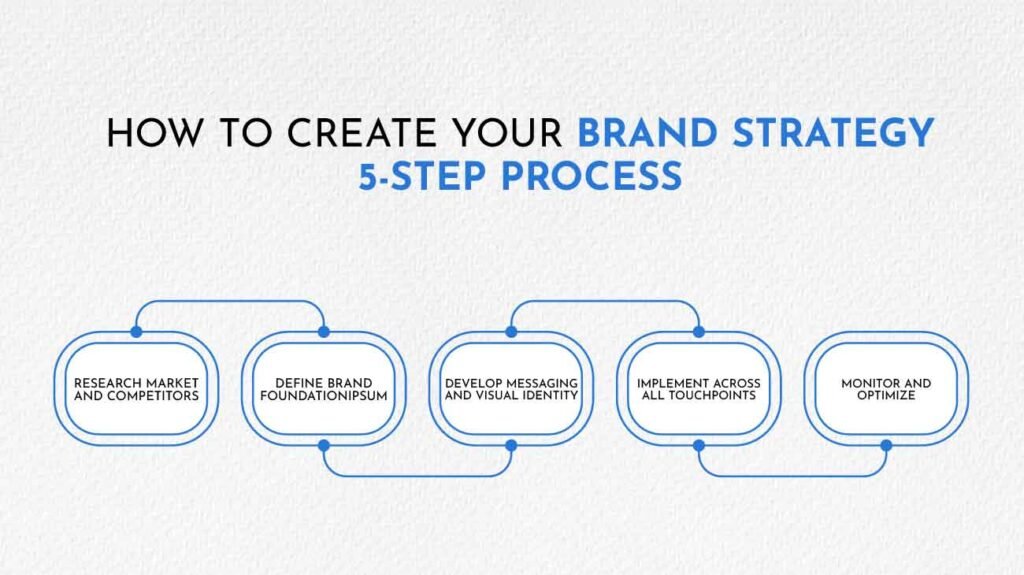
This systematic brand strategy development typically takes 4-8 weeks for small to medium businesses. The process works whether you’re launching a new brand or refining an established one. A brand strategist can help accelerate this process and ensure all the tools are properly implemented.
Before defining anything about your brand, you need to understand the competitive landscape you’re entering through comprehensive market research.
Start with competitive analysis. Study what your competitors stand for, their brand messaging, visual identity, and market position. A basic SWOT analysis helps organize your findings:
Read reviews of competitor products. Join social media conversations in your industry. Conduct surveys with potential customers. These insights reveal what your target audience actually wants versus what businesses think they want.
Create your core brand foundation statements. These become the anchor for every business decision moving forward and establish what your brand stands for.
Your Core Foundation Elements
LinkedIn’s mission provides a perfect example of clear mission and vision statements: “Connect the world’s professionals to make them more productive and successful.” Simple, clear, and actionable.
Craft Your Positioning Statement
Use the formula: “We help [audience] achieve [benefit] through [unique approach].” This positioning statement should differentiate you clearly from competitors while promising relevant solutions to your target customers.
Now you build the tangible brand assets that bring your foundation to life.
Create Your Messaging Framework
Start with your core message that expresses your value proposition. Then develop supporting points that reinforce this message from different angles. Document your brand voice guidelines. Is your tone formal or casual? Serious or playful?
Design Your Visual Identity
Work with a graphic designer or use tools to create:
Compile everything into simple brand guidelines that your team can reference. When choosing between custom design and templates, consider reading our comparison on custom website design vs template to make informed decisions.
Implementation happens in two phases: internal then external.
Internal Launch First
Your employees need to understand and embody your brand strategy before customers see it. Host brand training sessions that cover your brand’s purpose and core values, brand messaging and voice guidelines, visual identity standards, and how their role contributes to the brand experience.
External Launch Next
Update every customer-facing touchpoint: website copy and design, social media profiles and content, email marketing templates, product packaging or service delivery, and physical locations if applicable.
Brand consistency across all these marketing channels builds brand recognition. For e-commerce businesses, partnering with an e-commerce development company ensures your online presence reflects your brand identity perfectly.
Brand strategy is an ongoing process that requires regular attention and refinement.
Track the Right Metrics
Metric Category | What to Measure | Why It Matters |
Brand Awareness | Search volume, social reach, mentions | Are people discovering you? |
Brand Perception | Customer feedback, NPS, sentiment | What do they think of you? |
Business Impact | Conversions, retention, customer lifetime value | Is it driving results? |
Schedule quarterly reviews to assess these brand metrics. Conduct a comprehensive annual audit of your entire brand strategy. Learn more about measuring brand awareness to track your progress effectively.
Embrace Brand Agility
Modern brands must stay adaptive. Old Spice provides a masterclass in this balance. The brand completely pivoted its messaging and visual identity to reach a younger generation. But they kept their core values consistent. They changed expression, not essence.
When you pivot, adjust the how, not the why. Your brand’s purpose and values should remain stable. Your brand messaging, visual identity, and marketing strategy can flex to stay relevant.
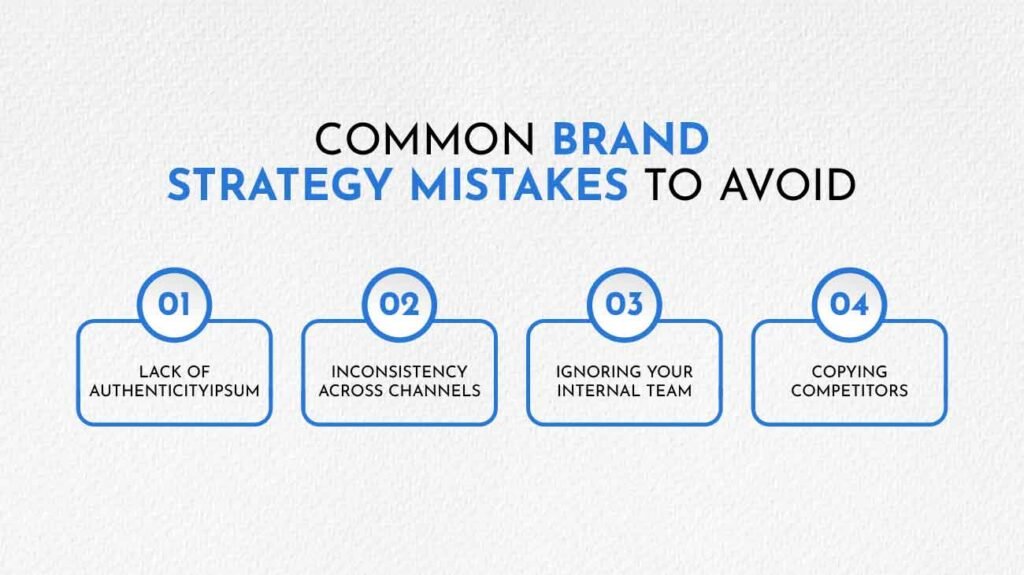
Recognizing these brand strategy pitfalls helps you avoid wasting time and resources.
Your brand’s purpose needs to be genuine, not manufactured for marketing. Remember when Pepsi tried to solve social justice issues with Kendall Jenner and a soda? Build your brand around true differentiators that you actually deliver.
Different looks, messages, or tones across marketing channels confuse your target audience. Create brand guidelines and actually use them. When every touchpoint reflects the same brand identity, you build familiarity that translates to customer loyalty.
When employees don’t understand or believe in your brand strategy, that disconnection shows to customers. If they can’t articulate your brand’s purpose or core values, how can customers? Invest in internal alignment through training and communication.
Following industry “best practices” might seem safe, but it makes you forgettable. Good brand strategies focus on brand differentiation, not imitation. Find your unique market position instead of doing what everyone else does.
An effective brand strategy delivers competitive advantage, customer loyalty, and the power to command premium prices. It’s essential for long-term business growth and brand equity in today’s crowded marketplace.
The path forward is clear: define your purpose, understand your target audience, create consistent identity, deliver exceptional experiences, then measure and optimize continuously. Each element builds on the others to create a comprehensive brand strategy that guides your marketing efforts and business objectives.
Begin by outlining three specific actions. The first is to collaborate with your team and key stakeholders to establish your brand’s purpose, clarifying its existence beyond the pursuit of profit.
Second, research and document your target audience by creating detailed personas of your ideal customers. Third, list your key elements that make you uniquely valuable in your competitive landscape.
Your brand is your business’s most valuable asset. The time you invest now in strategic branding will compound over years of growth, customer relationships, and market leadership. Great brand strategy isn’t built overnight, but every successful brand started exactly where you are today. The elements are clear, the process is proven.
So now it’s your turn to build something remarkable. If you need expert guidance, WebWonder Agency is here to help transform your brand vision into reality.
What is brand development strategy?
Brand development strategy is the systematic approach to building and evolving your brand over time. It includes defining your purpose, creating visual identity, developing messaging, and implementing experiences that strengthen brand equity and market position.
How do you build a brand strategy?
Build a brand strategy by researching your market, defining your brand foundation (purpose, mission, values), developing messaging and visual identity, implementing across touchpoints, and continuously monitoring performance to optimize and adapt.
How long does it take to create a brand strategy?
Creating a comprehensive brand strategy typically takes 4-8 weeks for small to medium businesses. The timeline varies based on company size, stakeholder involvement, and whether you’re building from scratch or refining an existing brand.
What’s the difference between brand strategy and marketing strategy?
Brand strategy defines who you are, what you stand for, and how you want to be perceived. Marketing strategy determines how you promote products and reach customers. Brand strategy guides marketing strategy.
Can small businesses benefit from brand strategy?
Absolutely. Small businesses benefit significantly from brand strategy. It helps you compete with larger companies through differentiation, builds customer loyalty, and guides decision-making as you grow. Strong branding levels the playing field.

Angela Schmidli is the Founder and CEO of Webwonder. She helps entrepreneurs and businesses build strong online identities through web design, branding, SEO, and strategic marketing.